
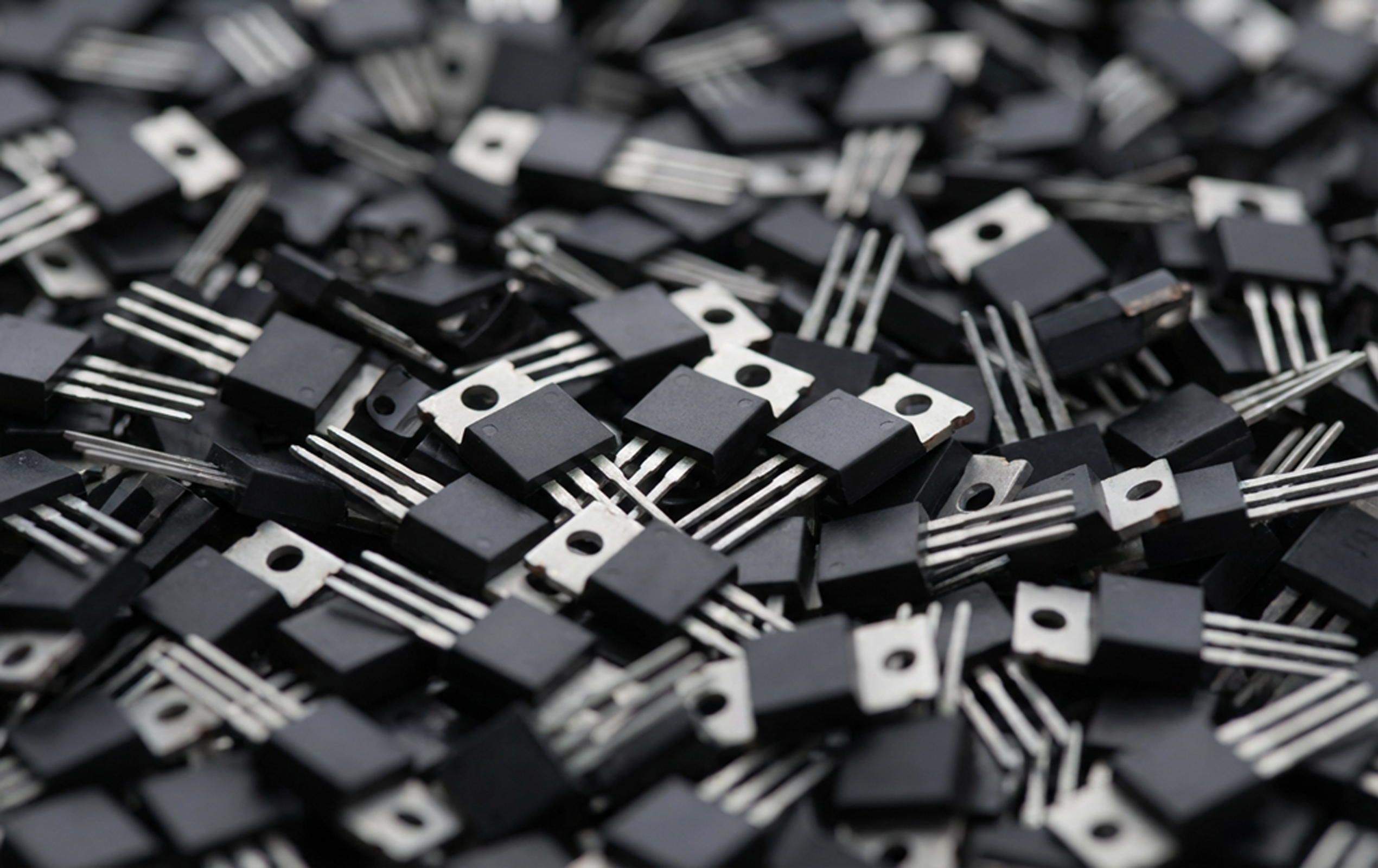
When people talk about “semiconductors,” they often mean computer chips (CPUs in laptops or GPUs in data centers). These devices process information and execute software.
But computation is only possible if energy can be delivered precisely, efficiently, and at scale. That critical job belongs to power devices, sometimes referred to as power semiconductors or power electronics.
While CPUs and GPUs handle information, power devices handle energy.

Two Very Different Jobs
At a basic level, all semiconductors control electricity. The difference lies in what they are controlling and how much of it.
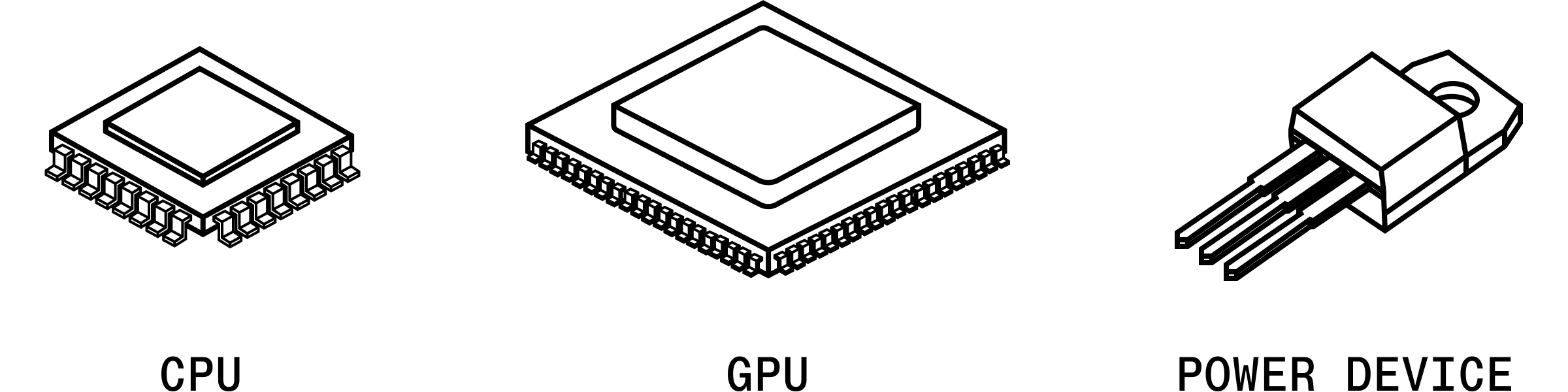
CPUs and GPUs are designed to perform computations on data. They operate at very low voltages and currents, switching billions of transistors to represent data and logic. Their value comes from density and speed.
Power devices are designed to control the flow of electrical power. They operate at tens to thousands of volts and high current. Their value comes from efficiency, robustness, and the ability to move real energy without loss or failure.
Computer chips do the thinking. Power devices keep everything alive.
What “Power” Actually Means Here
Power is how fast energy is used or moved.
Energy is the total amount of electricity available (the “how much”). Power is the rate at which that energy is delivered or converted (the “how fast”). A battery stores energy; power determines how quickly that energy can be turned into motion, heat, light, or computation.
In this context, “power” is literal. Power devices routinely handle tens, hundreds, or thousands of volts, along with significant current. They are the components that make it possible to take electricity from a wall outlet, a battery, or the power grid and turn it into something usable by electronics, motors, or industrial systems.
This is why power devices show up everywhere electricity needs to be transformed: in chargers, motor drives, solar inverters, data centers, electric vehicles, and grid-scale infrastructure. Any time energy changes form, AC to DC, high voltage to low voltage, battery to motor, power devices are involved.
They don’t decide what should happen. They make sure the energy flows correctly once that decision has been made.
How This Differs from CPUs and GPUs
The distinction becomes clearer when you look at design priorities.
A CPU or GPU is optimized to pack as much logic as possible into a small area. Power consumption matters mainly as a constraint on heat and performance. The individual transistors are extremely small and operate close to their physical limits.
Power devices, by contrast, are built around electrical endurance. Their internal structures are physically larger, their layouts are simpler, and their designs emphasize voltage tolerance, current handling, thermal performance, and long-term reliability. A power MOSFET or IGBT used in an electric vehicle or industrial system is expected to operate reliably for years under harsh conditions.
Both are “chips,” but they are solving fundamentally different problems.
Why Power Devices Matter More Than Ever
As the world electrifies, the importance of power devices is growing rapidly. Electric vehicles, renewable energy systems, data centers, and advanced manufacturing all depend on moving large amounts of energy efficiently. Improvements in power devices directly translate into higher efficiency, smaller systems, reduced heat, and lower overall energy consumption.
At the same time, today’s power devices are still constrained by the materials they are built from. Traditional silicon has been pushed close to its limits. Newer wide-bandgap semiconductor materials, such as silicon carbide (SiC) and gallium nitride (GaN), enable power devices to operate at higher voltages, higher temperatures, and faster switching speeds with lower losses.
What New Power Devices Unlock
While SiC and GaN represent a major step forward, materials currently emerging from research, such as gallium oxide (Ga₂O₃), promise a step change in both performance and production efficiency. These materials open the door to higher breakdown voltages, lower losses, and simpler device architectures that can support a more sustainable global electronic infrastructure.
Realizing this potential, however, depends not just on materials science, but on manufacturing. Many of these next-generation power devices require new fabrication approaches that prioritize flexibility, rapid iteration, and intelligent process control.
This is where AI-driven factories and more agile manufacturing models become critical. By combining advanced automation, data-driven process optimization, and specialized fabs, it becomes possible to bring breakthrough power semiconductor technologies out of the lab and into real-world systems faster.
Follow CubeFabs to learn more about how AI-powered factories are enabling the next generation of power devices and the materials that will define the future of electrification.